Broadcast Insights LLC

Broadcast Insights

Competitive broadcast intelligence for programmers, consultants, and group operators.

Broadcast Insights turns broadcast audio into structured intelligence.
Competitive clocks, morning show analysis, daypart analysis, and custom reporting.

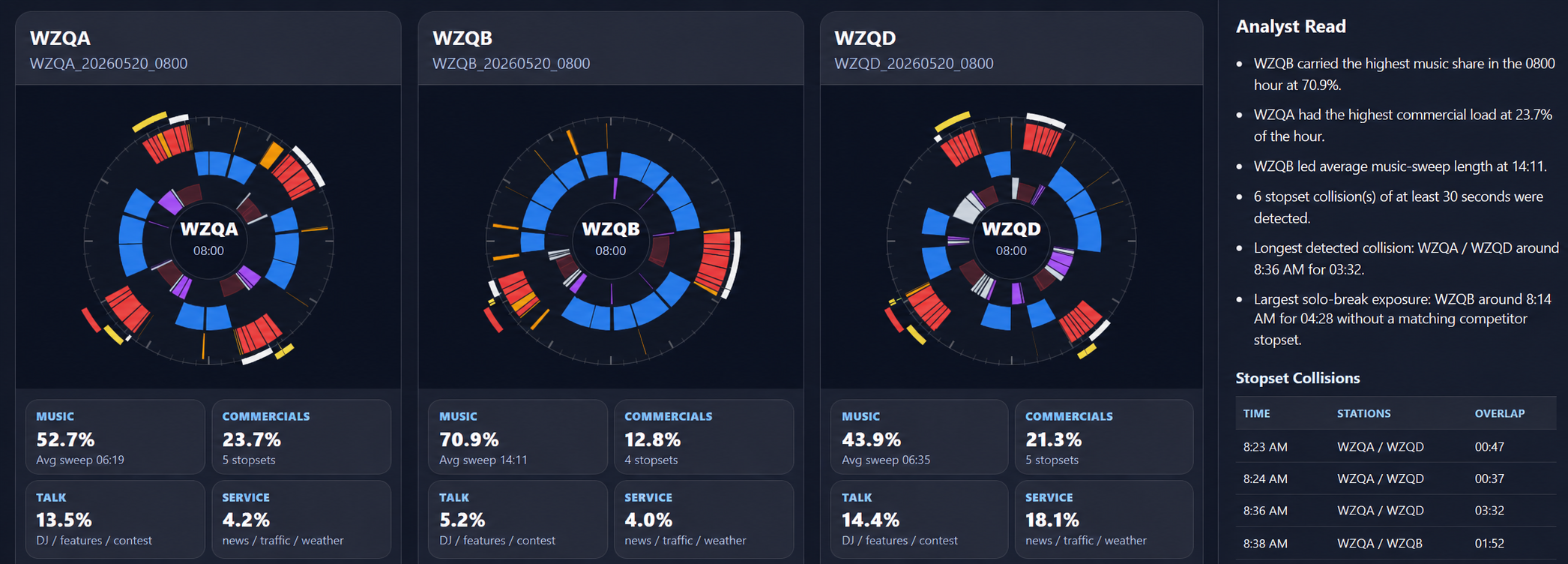
Three-station broadcast wheel comparison dashboard with analyst read panel

Competitive clarity from real broadcast audio

You know your clock. Now see theirs.

Stations often know music spins, but not the full listening experience: stopset placement, sweep length, promo load, talk breaks, sponsor integration, contesting, and commercial density.

Our reports turn the monitored hour into a visual, searchable, evidence-supported analytical reconstruction that helps programming teams compare structure, pacing, and competitive pressure.

Analysis packages

Every project starts with a structured one-hour intelligence foundation. From there, analysis can expand into competitive clock strategy, morning show evaluation, daypart studies, or custom reporting.

Broadcast Intelligence Foundation

The standard one-hour analysis package: a visual broadcast wheel, linear timeline, advanced metrics, and evidence drilldown built from the source audio.

  • Included base deliverable
  • Single station-hour analytical reconstruction
  • Visual, metric, and evidence views

Competitive Clock Intelligence

Builds on the foundation by comparing stations side by side to expose stopset collisions, music sweeps, commercial pressure, and clock structure.

  • Multi-station competitive context
  • Stopset and sweep comparison
  • Programming vulnerabilities and openings

Morning Show Analysis

Examines morning-drive content in depth, including topic flow, benchmark moments, contesting, sponsor mentions, localness, pacing, and competitive positioning.

  • Deep dive or comparison format
  • Talent and content coaching visibility
  • Morning-drive strategy support

Daypart Analysis

Applies the same structured framework to afternoons, middays, nights, weekends, or any other programmed block where pacing and competitive structure matter.

  • Afternoon drive, middays, nights, or weekends
  • Single-station or multi-station studies
  • Format and market strategy review

Simple workflow

Choose the stations and project scope, coordinate a clean monitored source, then review the finished analytical reports.

1

Choose targets

Select station, market, date, hour, daypart, and report package.

2

Coordinate monitoring

Use an approved source, authorized logger export, or Broadcast Insights Program Monitoring Appliance.

3

Analyze broadcast

Source audio is analyzed, classified, measured, and checked against evidence for report generation.

4

Review reports

Receive web-viewable reports with summary findings, visual clocks, timelines, and supporting detail.

Report products and examples

Each report is built from monitored broadcast audio, then organized into an analytical format that makes the hour easy to inspect, compare, and explain.

Standard foundation

Broadcast Intelligence Foundation

This is the standard foundation for a single station-hour. It includes the visual clock, the chronological analytical reconstruction, quantified metrics, and the evidence trail behind the analysis.

Analysis add-ons

Expanded analysis packages

These products build on the Broadcast Intelligence Foundation when the project requires competitive context, morning-drive detail, or deeper daypart strategy.

What each report is built to answer

The Broadcast Intelligence Foundation provides the standard one-hour reporting base. Expanded packages add competitive context, morning show depth, daypart strategy, or custom reporting layers.

Competitive Clock Intelligence

Shows how competing stations structure the hour and where their most important programming decisions occur.

Includes
  • Multi-station hour wheels and overlap analysis
  • Commercial stopset location, length, and collision windows
  • Music sweeps, talk breaks, imaging, promos, weather, traffic, and sponsor mentions
Why it matters

It helps identify where competitors are vulnerable, where they are protected, and how your own clocks can be positioned against them.

Best for

Program directors, consultants, market managers, and group programming leaders reviewing a competitive set.

Daypart Analysis

Extends the one-hour analysis framework across a defined daypart or recurring programming window.

Includes
  • Hour-by-hour structure and pacing review
  • Commercial load, music exposure, talk density, imaging, promos, and local service elements
  • Single-station trend views or multi-station competitive comparisons
Why it matters

It shows how a station or competitive set behaves across an entire programmed block, not just one isolated hour.

Best for

Program directors, consultants, market leaders, and group programmers evaluating afternoon drive, middays, nights, weekends, or special programming.

Morning Show Deep Dive

Examines one morning show in detail, including structure, pacing, recurring features, localness, topic selection, and sponsor integration.

Includes
  • Topic and bit flow by break
  • Commercial load, music balance, benchmark moments, contests, and listener interaction
  • Local service content such as news, weather, traffic, community references, and legal IDs
Why it matters

Morning drive is often the most personality-driven and revenue-sensitive daypart. This report exposes the real content strategy behind the show.

Best for

Program directors, morning show producers, talent coaches, consultants, and management teams evaluating a flagship show.

Morning Show / Daypart Comparison

Compares multiple shows or dayparts across stations to show structural differences, content priorities, and commercial pressure.

Includes
  • Station-by-station summaries and hour-by-hour comparisons
  • Talk density, music exposure, spot load, content categories, and localness
  • Competitive strengths, weaknesses, and differentiators
Why it matters

It turns subjective format impressions into measurable competitive context.

Best for

Group programmers, consultants, market leadership, and teams preparing strategy for a specific daypart.

Custom analysis by quote

Some projects do not fit neatly into a standard package. Broadcast Insights can quote custom reporting when a client needs a specialized workflow, private aircheck review, recurring monitor, or unusual market study.

Ultimate Aircheck

A private, evidence-first review of owned-station audio for coaching, quality control, talent review, and internal execution analysis.

  • Clickable or playback-enabled review when authorized
  • Segment-level transcript and evidence points
  • Break timing, execution notes, and coaching support

Custom reports

Available for projects that require a tailored scope, unusual stations or dayparts, recurring monitoring, market snapshots, advertiser/sponsor focus, or custom comparison logic.

  • Recurring station or market monitoring
  • Advertiser, sponsor, contest, or localness studies
  • Special-event, format-change, or launch analysis

Program monitoring and source delivery

Reports are only as useful as the monitored source audio is clean and complete. Broadcast Insights can analyze client-provided audio, authorized logger exports, approved internet stream sources, or project-monitored off-air audio, and can help define a monitoring plan for a station, daypart, market, or competitor set.

Client-provided or authorized sources

For owned-station audits or approved project situations, customers may provide complete audio files, logger exports, or other authorized source material.

  • One continuous file per station-hour is preferred.
  • Use a stable over-the-air source, approved internet stream monitoring, or authorized logger export whenever possible.
  • Include station call sign, date, start hour, time zone, and market notes in the file name or upload notes.
  • Avoid clipped starts, missing breaks, or partial-hour files when the goal is clock analysis.

Program monitoring support

When source audio is not already available, Broadcast Insights can help determine the best monitoring method and scope, including a temporary Program Monitoring Appliance deployment or approved internet stream monitoring where appropriate.

  • Define target stations, dates, dayparts, and reporting goals.
  • Plan single-market, multi-market, recurring-monitor, or stream-monitoring projects.
  • Coordinate secure delivery of project source files to the Broadcast Insights processing environment.
  • Confirm whether the project is for competitor research, internal aircheck review, or both.

Source audio use and report delivery

Broadcast Insights uses source audio as an input for analysis and report generation. Competitor-intelligence reports do not include playable source audio, downloadable airchecks, or source-audio redistribution. Source audio may be retained temporarily for processing, quality control, troubleshooting, and evidence verification, then deleted under the applicable retention policy.

Customer-provided audio files, logger exports, and customer-authorized program monitoring projects must be submitted or authorized by a party with the right or lawful authority to provide the material, operate the program monitoring workflow, or request the analysis.

Program Monitoring Appliances

For market projects where local monitoring is needed, Broadcast Insights can deploy a standardized appliance for monitoring. Appliance availability, pricing, and technical requirements are confirmed during project scoping.

Standard Program Monitoring Appliance

A portable four-station appliance for temporary or recurring market projects. This is the default field-deployed system for most early Broadcast Insights monitoring work.

  • Supports up to four monitored station/audio sources.
  • Customer provides power, Ethernet/network access, suitable antenna placement, and a local technical contact.
  • Local setup includes antenna connection, tuner power, tuner frequency selection, basic reception verification, and network integration.
  • Broadcast Insights supports the Windows/software configuration, project profiles, source-file transfer, processing, QC, and report generation.

Advanced Program Monitoring Workstation

A custom-configured higher-capacity workstation for larger market studies, longer-term deployments, HD Radio needs, or six-to-twelve-station monitoring.

  • Designed around integrated PCIe tuner hardware or HD-capable tuner hardware when required.
  • Customer requirements are scoped per project, including power, network access, placement, antenna/RF planning, and local technical support.
  • Suitable for group operators, consultants, recurring market coverage, and premium multi-station analysis.
  • Quoted individually based on channel count, HD requirements, deployment length, and support scope.

Standard appliance rental starting point

Minimum deployment: one week. First week including setup/configuration: $650. Additional weeks: $395/week. Refundable equipment deposit or replacement authorization: typically $1,750–$2,000. Shipping is billed separately or at cost unless a project quote states otherwise.

Rental pricing covers appliance availability and setup support only. Broadcast analysis, report packages, custom interpretation, expedited delivery, and recurring monitoring services are quoted separately.

Data and methodology

The workflow is designed to make radio programming structure visible without relying on station logs, traffic systems, or internal scheduling data from competitors.

What the system measures

  • Start and end timing for major broadcast elements
  • Music, talk, commercial, promo, imaging, news, weather, traffic, contesting, and sponsor categories
  • Stopset duration, placement, density, and competitive overlap
  • Transcript-backed content summaries and local service references
  • Song identification and advertiser or sponsor evidence when available

How results should be interpreted

Broadcast Insights reports are analytical reconstructions from monitored audio. They are intended for programming, competitive intelligence, coaching, and market research use.

Automated analysis is reviewed through source evidence and report-level quality checks, but ambiguous audio, compressed streams, poor reception, clipped files, rapid transitions, and overlapping elements can affect classification confidence.

Accuracy and evidence

Broadcast Insights uses reasonable efforts to reconstruct and classify broadcast content from available audio and supporting evidence. Reports may contain occasional omissions, timing variance, incomplete classifications, or missed elements, especially where audio overlaps, transitions rapidly, is partially obscured, or lacks clear recognition or transcription evidence. Reports are intended for broadcast intelligence and review, not as guaranteed verbatim logs, official station logs, legal records, ratings records, or traffic/reconciliation affidavits.

Frequently asked questions

Common questions about audio sources, report scope, use cases, and deliverables.

Do you need access to a station’s internal logs?

No. Competitive reports are built from monitored broadcast audio. Internal logs can help for owned-station QA, but they are not required for competitor analysis.

Can reports be created for dayparts other than morning drive?

Yes. Morning show products are built for a high-value daypart, but the same analysis framework can be applied to middays, afternoon drive, nights, weekends, or special events.

What audio quality is needed?

Over-the-air audio, approved monitored internet streams, and authorized logger exports can all work if the full hour is monitored without major gaps, dropouts, or clipping.

Can you compare multiple stations?

Yes. Multi-station packages can compare stopsets, music sweeps, talk breaks, format elements, and competitive openings across a defined station set.

Are the reports shareable?

Most analysis reports can be shared with authorized stakeholders. Playback-enabled aircheck reports are intended for authorized station-owner or subscriber use.

Can Broadcast Insights monitor internet streams?

Yes, when appropriate. For projects where client-provided audio is not available, internet stream monitoring can be discussed as part of the project scope, subject to station availability, stream reliability, source terms, access restrictions, timing requirements, and intended use.

What is a Program Monitoring Appliance?

It is a field-deployed Broadcast Insights system used to monitor approved broadcast sources for a specific project. The Standard Program Monitoring Appliance supports up to four monitored stations and requires local assistance for power, network integration, antenna placement, tuner selection, and initial testing. Broadcast Insights supports the software configuration, source-file transfer, processing, QC, and report generation.

What does the Standard Program Monitoring Appliance cost?

Standard starting terms are a one-week minimum deployment, $650 for the first week including setup/configuration, $395 per additional week, shipping billed separately or at cost, and a refundable equipment deposit or replacement authorization typically between $1,750 and $2,000. Analysis reports and custom interpretation are quoted separately.

Do competitor-intelligence reports include playable audio?

No. Competitor-intelligence reports are designed as analytical documentation, not audio redistribution. They do not include playable source audio, downloadable airchecks, or hosted competitor audio archives. Playback-enabled audio review is limited to owned or otherwise authorized station-audit workflows.

Are reports guaranteed to identify every broadcast element?

No report generated from monitored audio should be treated as a guaranteed identification of every millisecond of a broadcast. Broadcast Insights uses reasonable efforts to reconstruct and classify the hour accurately, with report-facing events supported by available evidence where applicable. Fast transitions, overlapping audio, unclear source material, music beds, imaging between songs, or low-quality audio can occasionally result in missed elements, timing variance, or incomplete classifications.

Do you accept ACH payments?

Payment options can be discussed after quote approval and handled through the invoice process. ACH may be available for approved business clients, but Broadcast Insights does not currently collect bank account information directly through this website.

How is pricing determined?

Pricing depends on the number of stations, hours, dayparts, turnaround requirements, report package, and whether program monitoring support or stream monitoring is needed.
Built for programming decisions

Designed for the people who need to understand how radio stations sound in the real world, not just how they were scheduled on paper.

Program Directors General Managers Radio Consultants Group Programming VPs Market Managers Talent Coaches